

Troubleshooting Belt Systems Using a Stroboscope
The stroboscope is a powerful diagnostic tool in predictive maintenance, production, quality control and research. Stroboscopes allow slow motion or stop action/visual inspection of rotating, linear or reciprocating objects. It is the ideal tool for troubleshooting belt-driven systems.
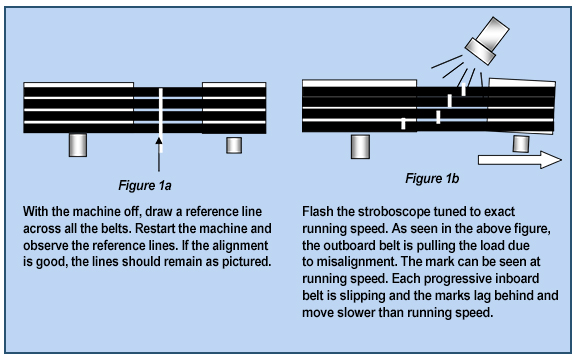
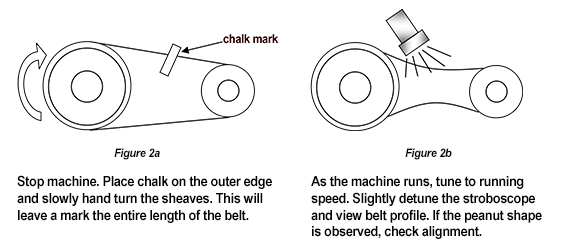
If you can, power the fan off. Then, use chalk or a paint stick to draw a line across all the belts (figure 1a). Draw another line along the entire edge of the outboard belt (figure 2a). Safely start the machine. Again, tune the stroboscope to running speed, now observe which belts are pulling the load (figure 1b). You should be able to spot the loose and stretched belts immediately.
For this example, our “machine” is a fan, belt‐driven by an electric motor. As the unit runs, tune the stroboscope to the operating frequency (running speed) of the drive pulley/sheave. Visually stop the motion. Inspect the belts and sheaves for signs of wear, cracks and frays. You can even read the exact part numbers, which is beneficial if a replacement is required.
Next, slightly detune the stroboscope, say 50‐100 CPM (RPM), and observe the outboard belt. If it draws a shape similar to a peanut (figure 2b), check your sheave alignment of the unit.
Can’t shut it down?
To check for belt slippage without shutting off the unit, do the following:
- Tune the stroboscope to the exact running speed of the sheave you want to inspect.
- Carefully view the belts at the sheave; the belts and the sheave should all appear stopped.
- If there is any slippage, you will see a belt slowly creeping while the sheave is “frozen.”
Taper-lock Sheaves (finding bent pulleys, shafts and blades)
Many belt systems make use of the taper-lock bushing on the sheave. Because unequal pull on the installing bolts can cause these sheaves to “tip,” use the following technique to check for axial concentricity.
- Tune the stroboscope to operating speed and observe the sheave.
- Double the speed of the stroboscope and observe the maximum displacement of the sheave.
- If the sheave appears to move a great deal, check the run‐out with a dial indicator and realign the sheave.
Note: This method will work for any rotating component when checking for maximum displacement. Belts, bent pulleys, bent blades and bent shafts may also be observed with this method.

Proper Tuning of a Strobe
When tuning the stroboscope, there are several times when the object will appear to be stationary. Stroboscopes should be used with caution. For safety, inform those around you that the shaft or rotating part is still moving but the strobing light makes it appear to be stopped. The highest CPM/RPM giving a single image is the exact running speed. Always check the drive unit name plate to confirm the actual running speed range. Other single images will occur at subharmonic rates (i.e. 1/2x, 1/4x, 1/8x running speed). Similar images can be seen by tuning to harmonics of operating speed (i.e. 2x, 4x, 8x, running speed). If looking at a shaft with one keyway, tuned to 3x running speed or the 3rd harmonic, three keys will be visible. It is important that you find the fundamental operating frequency for most
inspection techniques.
Triggering a Stroboscope
A stroboscope can be triggered typically from a TTL pulse signal. When the pulse hits the input, the stroboscope will flash. Various sensors and vibration analyzers can provide this type of pulse. When the stroboscope is triggered externally, the flash rate and phase will automatically be synchronized with the trigger signal. Monarch Instrument can provide Remote Optical Sensors, Magnetic Sensors and even Laser Sensors to trigger our Stroboscopes.
Phase Shifting
Internal phase shifting is a feature used on advanced stroboscopes, allowing the user to visually shift a reference mark to a different viewing position. This technique is useful when the reference mark is hidden or obstructed. Moving the reference mark is usually accomplished via a jog button, which relocates the image.
External phase shifting allows the tracking of variable speed machinery. External phase shift also allows a fixed delay in rotational degrees or time (µsec). The stroboscope flash is being delayed from an external trigger signal. This feature is used to look at an instant of a cyclical operation that differs from the timing of the trigger signal. For instance, you may be triggering off an engine at Top Dead Center (TDC), and the valves are open. If you wish to see the valves closed, you can shift the phase 180 degrees with the electronics of the Stroboscope.
Selecting a Stroboscope
In selecting a strobe, choose the type of power: AC or rechargeable batteries. When selecting a stroboscope, consider the speed of the equipment you wish to observe, the kind of environment, how bright the light should be and the triggering options. As just discussed, consider the need for phase shifting.
Summary
This article does not even begin to outline all the uses of the stroboscope in both maintenance and production. Stroboscopes can be used with video inspection systems for high-speed packaging, with vibration data collectors to provide phase studies and operational deflection shape (ODS) analysis to aid in dynamic balancing, and the list goes on. The stroboscope is a very cost-effective maintenance and quality assurance tool. It can save you time and money while providing real‐time information in a safe and repeatable method.

Stroboscopes by Monarch Instrument
Powerful visual inspection and speed measurement tools!
Monarch Instrument’s LED and Xenon strobes are feature-rich and versatile, and with so many model options, you know that Monarch makes a strobe that’s perfect for your application. Check them out!


