

Proven Condition Monitoring Strategies for Excellent Machinery Health
Condition monitoring is the process of tracking machinery and system health in real time or through periodic checks to detect early signs of wear, faults, or anomalies before a breakdown occurs.
Table of Contents
How It Works
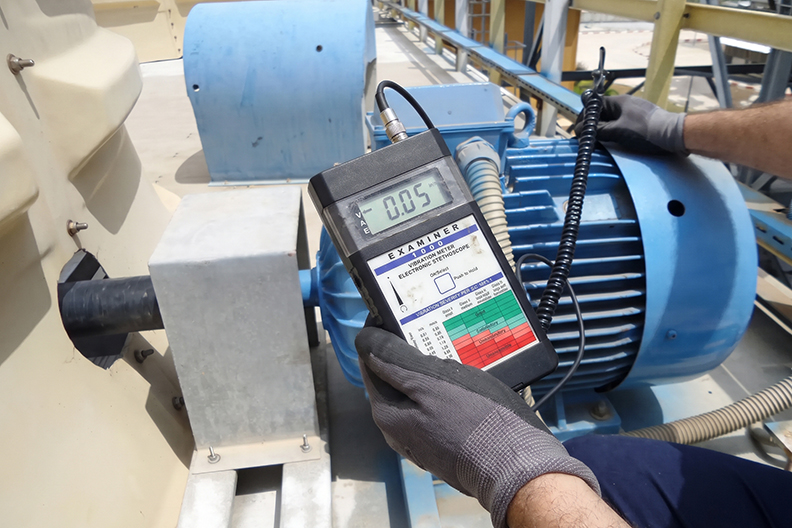
Portable instruments, such as Monarch Instrument’s EXAMINER 1000 Vibration Meter, are placed directly on machinery to measure physical parameters such as vibration. Tachometers, data loggers and sensors measure other key parameters such as speed, temperature, and pressure. Recording data while equipment runs normally establishes a baseline, or reference point, for future comparison. New readings are then compared against that baseline. When values drift, patterns change, or a set threshold is exceeded, an alert is triggered so the team can act before a failure occurs.
Common Parameters Monitored
- Vibration Analysis: Detects bearing wear, rotor imbalance, misalignment, and loose parts in rotating equipment.
- Temperature: Tracks overheating in motors, gearboxes, electrical panels, and bearings.
- Oil & Lubricant Analysis: Checks for internal wear particles, chemical breakdown, or contamination in hydraulic systems and engines.
- Pressure and Flow: Monitors performance shifts in pumps, compressors, and piping systems.
Key Benefits of Condition Monitoring
- Prevents unplanned downtime by detecting problems early
- Saves money by lowering repair costs and avoiding wasting resources on unnecessary maintenance of healthy machines
- Improves safety by reducing the risk of dangerous equipment blowouts, leaks, or sudden component ruptures
- Extends equipment life by addressing small issues before they become major
Condition monitoring acts as the core data-gathering layer for broader predictive maintenance PdM strategies.
The five elements of condition monitoring are data collection, data analysis, alert generation, maintenance planning and continuous improvement. Monarch Instrument offers the tools for the first three, making the last two easy and cost effective.
Data Collection
Monarch Instrument products collect critical condition monitoring data using portable meters, standalone loggers, and precision optical sensors. They translate physical variables like speed, vibration, and pressure into actionable digital datasets using in three key areas:
Vibration Detection
The EXAMINER 1000 Vibration Meter uses a contact accelerometer probe and a magnetic base to measure acceleration, velocity, and acceleration enveloping directly from machine housings.
As an overall vibration meter with electronic stethoscope, the EXAMINER 1000 can be used as a stand-alone device for the collection of vibration data for trending or as a diagnostic instrument for troubleshooting machinery defects enabling maintenance teams to “listen” to bearing wear or fluid abnormalities in real time. Combining an overall vibration meter with an electronic stethoscope, the EXAMINER 1000 works both as a stand-alone tool for collecting vibration data to trend over time and as a diagnostic instrument for troubleshooting machinery defects. The stethoscope function lets maintenance teams “listen” for bearing wear or fluid abnormalities in real time.
Speed Tracking (RPM)
Monitoring rotor or shaft speed (RPM — revolutions per minute) is vital in condition monitoring because machine vibration frequencies scale directly with speed.
Laser tachometers, such as the PLT200 Pocket Laser Tachometer, improve condition monitoring by providing highly accurate, non-contact, real-time speed data that is essential for tracking changing mechanical loads and analyzing vibration signals.
Because the PLT200 can work from a distance of up to 25 feet using a reflective target (such as T-5 Reflective Tape), technicians can safely monitor high-speed shafts, hot components, or tightly enclosed machinery without physical contact or equipment shutdown.
PLT200 + Remote Optical Sensor: By tracking exactly when a reflective tape strip passes the laser beam, the sensor establishes a phase reference. This allows maintenance teams to distinguish between similar faults like unbalance, structural looseness, or shaft misalignment.
Stop Motion Visual Inspection/Speed Measurement
The Nova-Pro® 300 and Nova-Pro® 500 LED Laser Stroboscopes/Tachometers improve condition monitoring by providing optical stop-motion visual inspection and precise speed measurement without stopping the machinery. While a laser tachometer gives a digital RPM readout, a stroboscope uses synchronized, high-intensity light flashes to make fast-moving components appear completely stationary or in slow motion. Like the PLT200, the Nova-Pro 300 or 500 Stroboscope measures exact rotational speed safely from a distance. However, it does not require reflective tape to be pre-applied to the shaft, making it ideal for quick diagnostic checks.
By matching the flash rate to the machine’s RPM, technicians can visually inspect moving parts in real time. This allows you to spot cracked fan blades, slipping belts, misaligned couplings, and structural flexing while the asset runs under full load.
Data Analysis
Monarch Instrument products provide data analysis by helping customers turn accurate measurements into meaningful information they can use to evaluate equipment performance, identify potential problems, and make informed maintenance decisions.
Environmental and Process Recording
Track-It™ Data Loggers are highly effective in condition monitoring because they automatically collect, record, and store continuous operational data over preset periods without requiring a human technician to be present.
By continuously capturing parameters like temperature, pressure, vibration, and electrical current, data loggers bridge the gap between spot-check maintenance and expensive, fully automated continuous monitoring systems.
The Track-It™ Data Logger series features compact, battery-powered stand-alone units deployed directly inside operational environments. They log up to 64,000 cyclic parameter samples—including vacuum pressure, ambient temperature, relative humidity, and DC voltage/current—using programmable internal clocks to establish trend lines over time.
Why Choose Monarch Instrument?
A condition monitoring program is only as good as the data behind it. Tracking rotational speed and other operating variables provides the baseline metrics needed to catch faults early, and that takes accurate, industrial-grade instruments.
Using Monarch Instrument provides several key operational benefits:
- All-in-One Multifunctional Diagnostics: Tools like the Nova-Pro Series act simultaneously as high-intensity stroboscopes and precision laser tachometers, enabling you to switch seamlessly from stop-motion inspection to digital RPM tracking on a single tool.
- Uncompromising Data Integrity: With available NIST Traceable Calibration Certificates for Monarch Instrument tachometers and stroboscopes, maintenance teams can trust that baseline trends are built on accurate, verifiable measurements.
- Ruggedized Multi-Parameter Logging: For long-term monitoring, their Track-It Data Loggers capture up to 130,000 continuous samples of temperature, pressure, split-cycle current, and shock events. Built to withstand hostile plant environments, these instruments survive where consumer electronics fail.
- Seamless Field Customization: From self-powered smart laser sensors that track speeds from up to 65 feet away, to internal phase shifting for analyzing hard-to-reach couplings, their ecosystem adapts directly to complex, tight, or variable-speed configurations.
Ultimately, the right diagnostic tools close the data gaps left by manual route inspections, helping you catch mechanical degradation safely before it triggers a catastrophic failure.


