

Nova-Pro® UV365 vs. UV385: Which Ultraviolet Stroboscope is Right for Your Inspection?
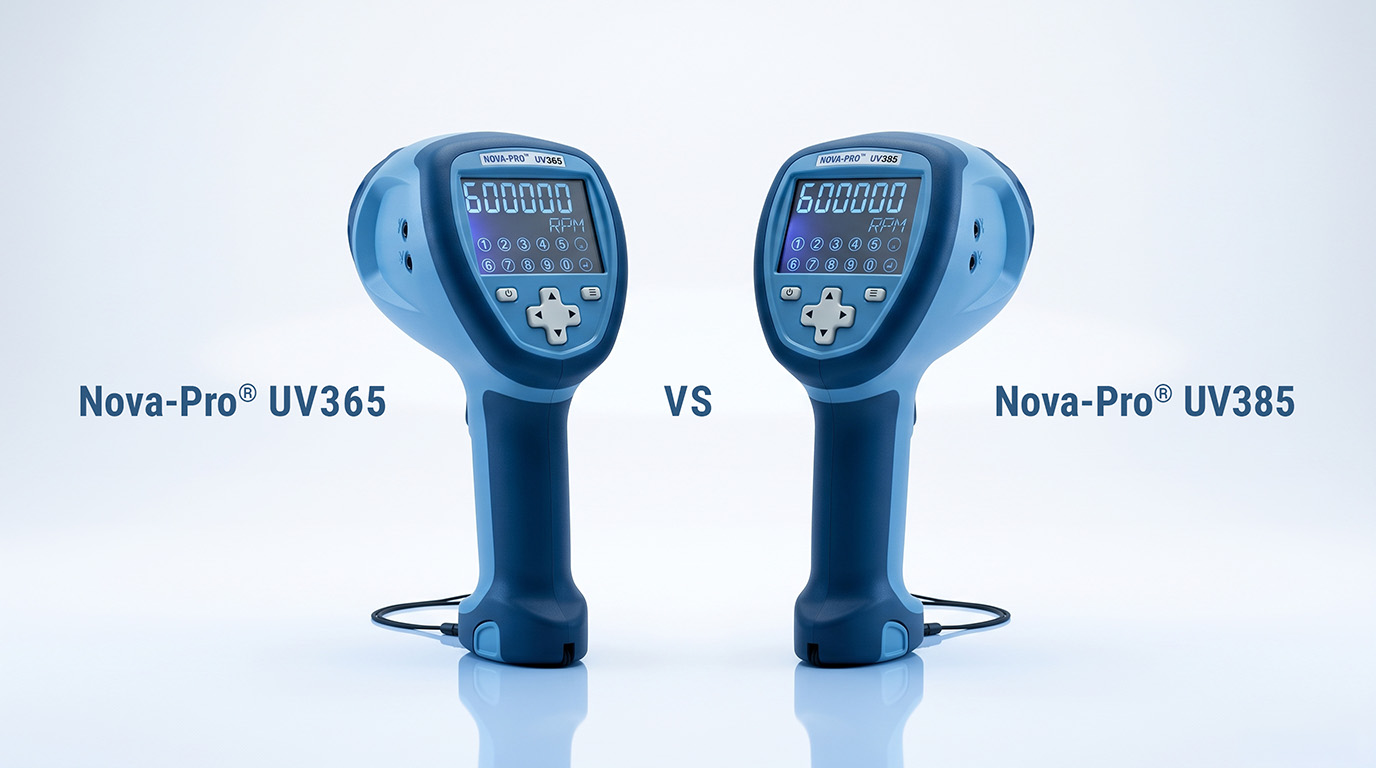
The Nova-Pro® UV series brings stop-motion inspection to ultraviolet applications for the inspection of security marks, invisible ink codes, taggants and UV coatings on a web running at full production speed. Both the Nova-Pro® UV365 and the Nova-Pro® UV385 are stroboscopes and fully functional laser tachometers. Both are a single tool for visual inspection, speed verification and troubleshooting of high-speed automation in virtual slow motion.
Nova-Pro® ultraviolet strobes come in two wavelength options, and they are not interchangeable. This guide explains the difference between the Nova-Pro® UV365 and the Nova-Pro® UV385, helping you select the right model.
Table of Contents
The Only Difference Between the Nova-Pro® Ultraviolet Stroboscope Models is the LED Array
Much about the Nova-Pro® UV platform is common to both units; each has the same optics housing, controls, laser tachometer, and battery system. Both models come with the same NIST Traceable Certificate. The only difference is the wavelength of the twelve ultraviolet LEDs, which determines whether your mark glows or stays invisible.
| Nova-Pro® UV365 (PN: 6248-010) | Nova-Pro® UV385 (PN: 6249-010) | |
|---|---|---|
| LED Array | Twelve 365 nm ultraviolet LEDs | Twelve 365 nm ultraviolet LEDs |
| Best For | Surface-printed fluorescent marks and taggants | Marks under white ink, varnish or lamination |
| Visible Light Spill | Minimal (highest contrast on faint marks) | Faint Violet (confirms the lamp is firing) |
| Coating Penetration | Limited through titanium dioxide (TiO2) – loaded white ink | Better — passes above the ~380 nm TiO2 (titanium dioxide) cutoff |
| Typical Ink Spec | Excitation peak 350-370 nm (most common) | Excitation specified 385-395 nm |
Nova-Pro® UV365 is the Universal Choice for Most Ultraviolet Inspection and Fluorescent Ink Inspection Applications
Most security dyes, invisible taggants and optical brighteners have their excitation peak in the 350–370 nm band, and ink manufacturers commonly specify 365 nm as the recommended excitation wavelength. Looking at a typical excitation curve, 365 nm sits at or very near the peak, which means more of the energy you put on the substrate comes back as visible fluorescence.
Just as importantly, a 365 nm LED emits nearly pure UV-A with very little visible light content. Your mark glows against a near-black background rather than a violet wash. When an operator is reading a faint code on a moving web by eye, that contrast is what makes the tool work — and it is the single biggest reason 365 nm outperforms longer wavelengths on weak or low-concentration marks.
Typical Applications
- Surface-printed security marks
- Invisible ink bar codes
- Anti-counterfeiting features
- Pharmaceutical packaging verification
- Monetary and identity documents
- Textiles and OAA coatings
- Liquid and magnetic dye penetrant NDT
- Faint or low-concentration taggants
When to Choose the Nova-Pro® UV385
- The mark is buried under something. Titanium dioxide in white ink blocks ultraviolet below roughly 380 nm. If your fluorescent layer sits beneath white ink, a varnish, a topcoat or an overlaminate, a 365 nm source may be absorbed before it ever reaches the ink. At 385 nm you are above that cutoff, and the energy gets through.
- Your ink is specified for a longer wavelength. Some newer LED-optimized taggants are formulated to excite in the 385–395 nm range rather than the traditional 365 nm band. Your ink supplier’s technical data sheet will say so.
- Your substrate fights you. Papers heavily loaded with optical brighteners can light up under 365 nm and swamp the UV mark you are trying to read. Shifting to 385 nm sometimes suppresses the background glow more than it suppresses the code, recovering usable contrast.
- You want a visible cue. 385 nm puts a faint violet color on the work surface, confirming immediately that the lamp is firing — useful in a busy pressroom.
Two Questions That Settle Which Model is Best to Use
1. Who makes your ink, and what is the product code?
Your ink supplier’s technical data sheet (TDS) will list a recommended excitation wavelength or show an excitation curve. That single data point answers the question outright, and we are happy to review it with you.
2. Is the mark on the surface, or under a coating?
Surface-printed marks favor 365 nm. Marks beneath white ink, varnish or lamination favor 385 nm. If you run a mix of ink chemistries and can only buy one unit, 365 nm is the safer default — unless most of your work sits under a clear or white overprint, in which case specify 385 nm
If you run a mix of ink chemistries and can only buy one unit, 365 nm is the safer default — unless most of your work sits under a clear or white overprint, in which case specify 385 nm.
A Note About UV Curable Inks
UV curable inks are cured by ultraviolet light but are usually not fluorescent. If you are inspecting print registration or hunting defects in standard process colors, an ultraviolet strobe will not help — you want a white-light Nova-Pro® 300 or 500.
Safety: Ultraviolet output is intense. Operators should wear UV-blocking eyewear and must not view the LED array directly. Specifications are subject to change without notice; refer to the current Nova-Pro® UV Stroboscope/Tachometer datasheet for full specifications.
Contact us and we will point you to the optimal model.


