

4 PLT200 Modes of Operation Explained: Tachometer, Rate Meter, Totalizer & Timer Functions
What Modes of Operation Are Available on the PLT200 Tachometer?
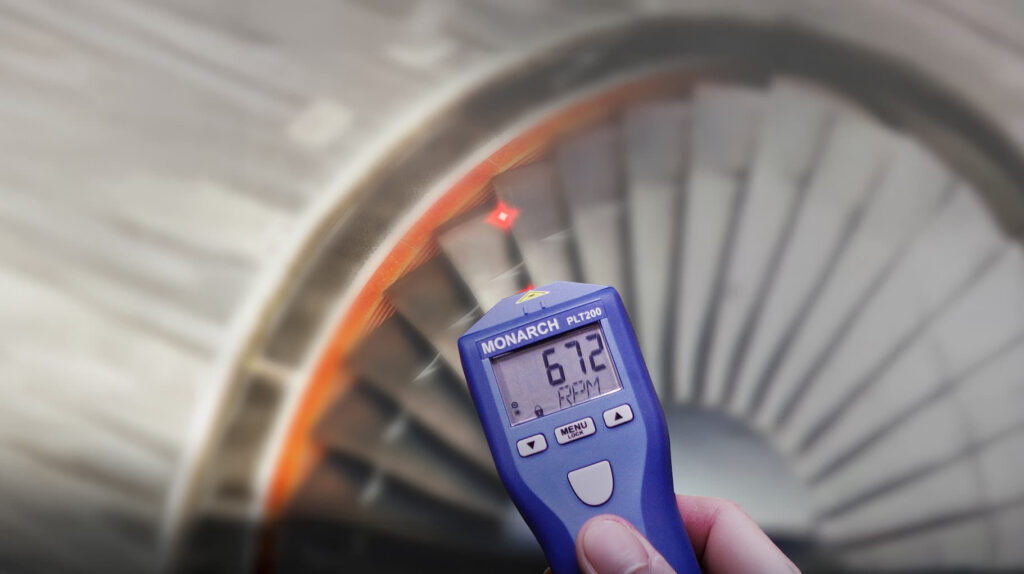
The Pocket Laser Tachometer 200 (PLT200) is our best-selling tachometer. It’s also a multifunction tachometer, rate meter, totalizer and timer in one handheld device It is programmable to read in English or metric units. An input socket accepts remote sensing devices, and an output socket allows for pulse output to external indicating devices. The PLT200 can be tripod mounted hands-free, continuous operation and stores minimum, maximum, and last measurements in memory.
The PLT200 combines several measurement capabilities in one instrument. Its tachometer and rate functions can display rotational and linear speeds in a variety of units. Because linear measurements can be programmed in both English and metric units, many speed functions effectively double—for example, inches/minute and centimeters/minute or feet/minute and meters/minute.
When the available tachometer, rate, totalizer, and timer functions, measurement units, and optical and contact measurement options are considered together, the PLT200 provides 32 selectable functions.
Table of Contents
1. TACH (Tachometer) Mode
Answers the Question: How Fast is the Object Rotating?
A tachometer measures speed or linear rate with respect to time; time intervals are seconds, minutes, or hours. Rotational speed can be measured in Revolutions (Revs) per second, per minute, or per hour. The most common measurement is RPM or Revs per minute using the optical Tachometer Mode.
Key Aspects of Tachometer Mode
| RPM measurement | Displays rotational speed directly in revolutions per minute (RPM). |
| Wide measurement range | Suitable for measuring both relatively slow and high-speed rotating equipment. |
| Real-time readings | Provides a continuously updated speed measurement as the equipment operates. |
| Min/Max capability | Can capture minimum and maximum speed values, useful for identifying speed fluctuations or changes during operation. |
| Multiple sensing options | The PLT200 can work with Monarch Instrument speed sensors, allowing it to be used in different measurement setups and applications. |
| Target-based optical measurement | For non-contact measurements, reflective tape or another suitable target is typically placed on the rotating shaft. The sensor detects each pass of the target and converts the pulse rate into RPM. |
| Useful for maintenance and troubleshooting | Tachometer measurements can help verify motor speeds, check operating conditions, identify speed variations, and confirm that equipment is operating within its expected range. |
| Non-contact measurement | When used with the appropriate optical sensor, the PLT200 can measure speed without physically contacting the rotating equipment. |
How to Use the PLT200 as a Contact Tachometer
The Remote Contact Assembly (RCA) is an accessory that converts the PLT200 into a contact tachometer allowing users to measure contact RPM, linear speed, or totalized length. The maximum operating range is 20,000 RPM when used with a contact tip and 12,000 RPM when used with a linear wheel. The RCA outputs 12 pulses per revolution (PPR).
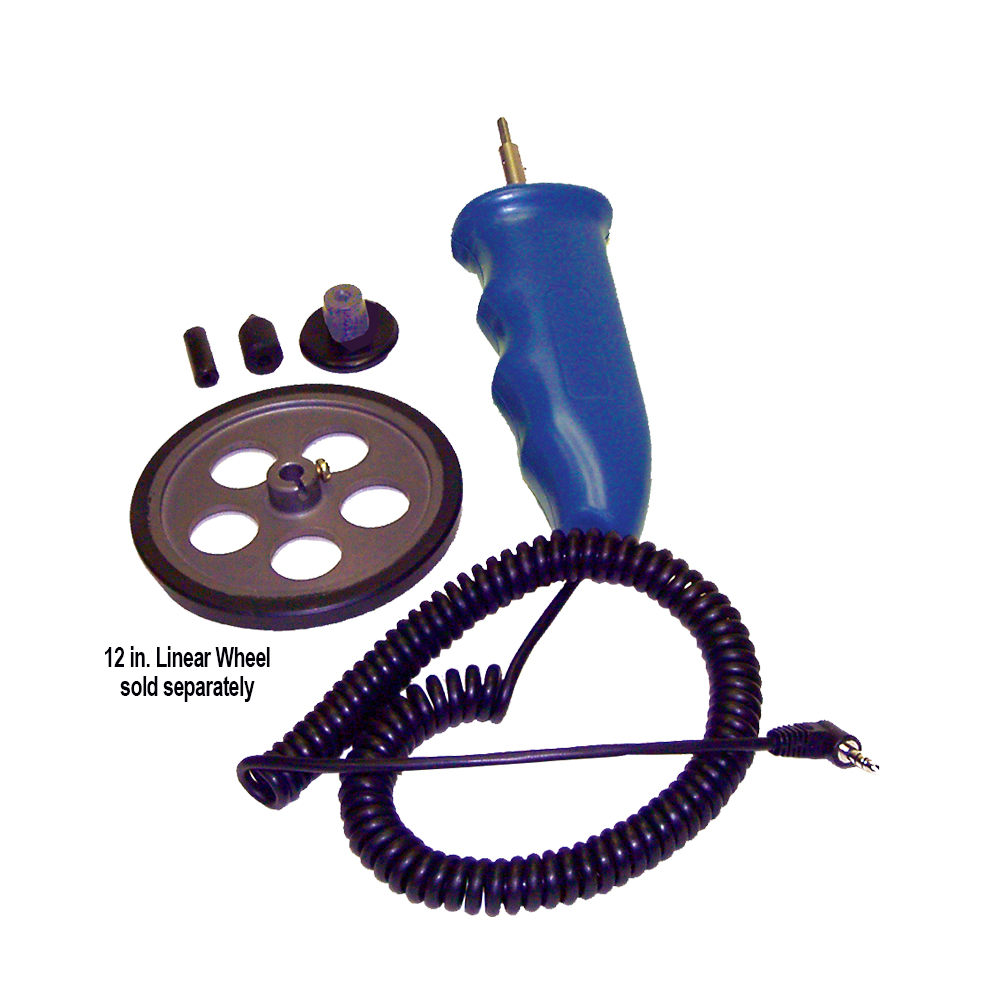
The Remote Contact Assembly is included in the PLT200 Kit and is also sold separately. It must be plugged into the PLT200 to be functional. It is supplied with two rubber contact tips (one concave and one convex) and a 10 cm linear wheel. An optional 12-inch Linear Wheel is also available.
2. RATE Mode
Answers the Question: How Frequently is an Event Occurring?
The Rate function measures the frequency of incoming pulses and expresses that frequency as a useful rate, such as revolutions per minute, cycles per minute, or units per minute.
In applications involving rotating equipment, a sensor generates pulses as a shaft rotates. The PLT200 measures the frequency of those pulses and converts them into the selected rate.
For Example:
- 1 pulse per revolution + 1,800 pulses/minute = 1,800 RPM
- 10 pulses per revolution + 18,000 pulses/minute = 1,800 RPM
Why Would You Use the PLT200 as a Rate Meter Instead of a Tachometer?
The two functions are closely related because both can determine a rate from incoming pulses. The distinction is primarily in how the measurement is applied and displayed.
- Tachometer Mode: How fast is this rotating or moving object?
- Rate Mode: How frequently is this event occurring?
The Rate Mode is useful for applications where the input represents repetitive events rather than simply the speed of a rotating shaft.
Rate measurements can be useful for monitoring:
- Shaft rotation
- Conveyor speed
- Production rate
- Pump cycles
- Fan or motor speed
- Flow pulses
- Machine cycles per minute
3. TOTALIZER Mode
Answers the Question: How Many Events Have Occurred in Total?
Unlike Tachometer or Rate Mode, which provide a rate at which something is happening, the Totalizer accumulates incoming pulses over time and provides a running total.
In its simplest application, the PLT200 acts as an electronic counter, incrementing the display each time an input pulse is detected.
With the Remote Contact Assembly and appropriate tips or wheels, the PLT200 can also totalize measurements such as:
- Revolutions
- Inches
- Feet
- Yards
- Centimeters
- Meters
Rate Mode vs. Totalizer Mode
The easiest way to understand the difference is:
- Rate: How fast is it happening?
- Totalizer: How much has happened altogether?
For example, a production machine may be running at 100 cycles per minute. That’s a rate measurement.
Where Are Totalizers Useful?
Totalizing can be useful for tracking:
- Total revolutions
- Total machine cycles
- Total products produced
- Total batches
- Total length of material
- Total operating events
- Total flow, when connected to an appropriate flow signal
4. TIMER Mode
Answers Questions: How Much Time Passes Between Events? How Long Does Something Take?
Timer Mode measures elapsed time or the time interval associated with an event. This makes it useful when you’re interested in the period of an event rather than its frequency or accumulated count.
The PLT200 Timer accumulates time in minutes, seconds, and tenths of a second and provides two modes of operation.
- Manual Mode: Manual Mode operates like a stopwatch, with the timing period started and stopped by the user.
- Auto Mode: Auto Mode can be started and stopped by the user or by a piece of reflective tape on an object being monitored.
The display can also be frozen to view or record a LAP time without affecting the count.
- Timer Mode and Rotating Equipment: When the PLT200 receives pulses from a sensor monitoring a rotating shaft, Timer Mode can measure the time between successive pulses. In this way, Timer Mode provides another way of understanding the behavior of a repeating signal by looking at the time between events.
For Example:
If one pulse is generated for every revolution and the PLT200 measures 0.5 seconds between pulses, the shaft is completing one revolution every half-second.
The relationship between period and frequency is: Frequency = 1 ÷ Period1 ÷ 0.5 seconds = 2 Hz
And because there is one pulse per revolution: 2 revolutions/second × 60 = 120 RPM
A Simple Way to Think About the Four PLT200 Modes
Tachometer Mode: How fast is it rotating or moving? → RPM/linear speed
Rate Mode: How frequently is it happening? → Events per unit of time
Totalizer Mode: How many have happened? → Total count/accumulated length
Timer Mode: How much time passes between events? → Elapsed time/period
One Tachometer. Four Measurement Capabilities.
The PLT200’s versatility comes from combining these measurement functions with multiple units and sensing options in a single handheld instrument.
Whether you’re checking the RPM of a motor, monitoring a production rate, counting total revolutions, measuring material length, or determining the time between machine cycles, the PLT200 provides a flexible way to measure and understand what’s happening on your equipment.
One instrument. Multiple ways to measure. That’s the versatility of the PLT200.


